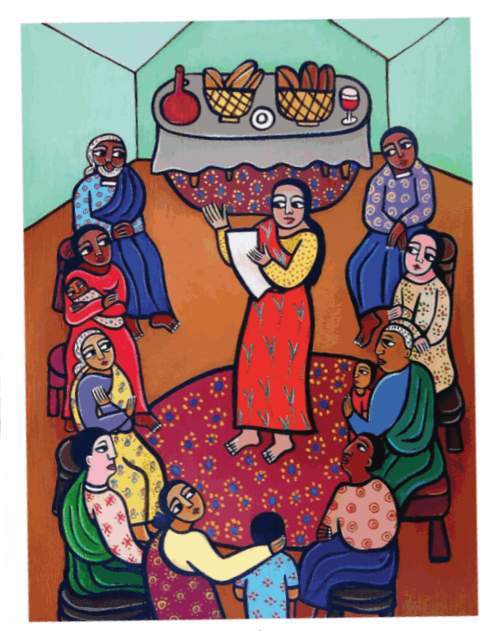
Women’s gifts for the church

Charlie Dittmeier's Home Page
The Catholic Church in Cambodia.


The Khmer Rouge ruthlessly attacked the leaders of the Catholic Church and other religious leaders. The bishop at that time and eleven other church leaders have been proposed for canonization as modern martyrs for the faith. Pope Francis asked the present bishop, Bishop Olivier Schmitthaeusler, in 2015 to start the process and it has just now concluded and the evidence and documentation required has been sent to Rome.
Bishop Olivier, Apostolic Vicar of Phnom Penh, solemnly closed the diocesan inquiry for the beatification of the Presumed Martyrs of Cambodia: The Servants of God, Bishop Joseph Chhmar Salas and his 11 Companions. Here is his statement:
These Servants of God — bishop, priests, religious, and laity — gave heroic witness to Christ amid the Khmer Rouge communist genocide (1975–1979), a brutal regime that caused the deaths of an estimated 1.5 to 3 million Cambodians through execution, starvation, forced labor, and persecution of faith.
After 10+ years of work, nearly 2,500 pages of testimonies and documents — radiant signs of faith in the darkness — are sealed and will soon go to Rome.
Pray fervently that they may soon be recognized by the Universal Church as models of charity and martyrdom.
As Bishop Salas said before his exile and death:
“Speak of us to the world.”
50 years later, we still do.


A further reflection on immigration from Pope Francis’ encyclical, #44:
We forget that “there is no worse form of alienation than to feel uprooted, belonging to no one. A land will be fruitful, and its people bear fruit and give birth to the future, only to the extent that it can foster a sense of belonging among its members, create bonds of integration between generations and different communities, and avoid all that makes us insensitive to others and leads to further alienation”.
Here is a wonderful summary of what God is all about, of what we should all be about. It comes from Daily Prayer 2026:
The heart of God’s law is creating a community in which all are regarded equally as his children. This is the most important law of God—by loving others, we love him.
It’s rather simple. Can we do it? Will we do it?
A central idea of the Buddha and his teaching is that desire is the root cause of human suffering. “From craving (desire) springs grief, from craving springs fear. For one who is free from craving, there is no grief and so no fear” is a quote attributed to Buddha.
He doesn’t say to want nothing but that suffering comes from coveting and attachment to things, and if we want peace, we must understand desire and the control it can produce over us.

A contemporary spiritual writer, Margaret Silf, offers a healthy understanding of desire:
We tend to think that if we desire something, it is probably something we ought not to want or to have. But think about it: without desire we would never get up in the morning. We would never have ventured beyond the front door. We would never have read a book or learned something new. No desire means no life, no growth, no change. Desire is what makes two people create a third person. Desire is what makes crocuses push up through the late-winter soil. Desire is energy, the energy of creativity, the energy of life itself. So let’s not be too hard on desire.

“Even in social company people often slide into a kind of connected isolationism, in which ordinary conversational connection seems to be undermined by the near-addictive grip within which the machine holds us. We tend to exalt the value of such connectedness without acknowledging the divisive effect it can have on our senses, our emotions, our relationships, and our need for times of solitude and quiet. From a spiritual perspective the electronic gadgetry can easily become a compensatory “god” on whom we depend for the satisfaction and fulfillment of our most basic needs.”
From Diarmud O’Murchu’s Ecological Spirituality

• Chicago Cardinal Blase Cupich celebrated an outdoor Ash Wednesday mass in solidarity with immigrants being terrorized and detained.
• Newark Cardinal Joseph Tobin made it a priority to celebrate an Ash Wednesday litugy inside an immigrant detention center.
“What we are seeing is a genuinely prophetic answer to a call from the heart of the Gospel. It is an urgent response to an extreme moment. The answer is delivered with language and action that attempt to counter an out-of-control government and its multiple assaults on human dignity and the rule of law.”
[Photo and quote from a National Catholic Reporter editorial]